濟南濟柴環能燃氣發電設備有限公司
—— 燃料發電設備及機組相關配套設備及配件 ——
—— 燃料發電設備及機組相關配套設備及配件 ——
 全國服務熱線:

全國服務熱線:
 濟南濟柴環能燃氣發電設備有限公司
聯系電話:羅總18653152416
服務熱線:0531-62325028
聯系地址:中國(山東)自由貿易試驗區濟南片區孫村街道經十東路33688號章錦綜合保稅區聯東U谷科創中心5號樓101
在全球能源結構向清潔化、低碳化轉型的背景下,生物質能源作為唯一可轉化為氣體、液體和固體燃料的可再生能源,其開發利用備受關注。生物質氣化發電技術通過將農業廢棄物、林業剩余物、畜禽糞便等生物質原料轉化為可燃氣體,再驅動發電設備產生電能,實現了 “變廢為寶” 與能源供應的雙重價值。該技術不僅能緩解傳統化石能源短缺壓力,還能減少農業、林業廢棄物焚燒帶來的環境污染,在農村地區、工業園區及偏遠區域具有廣闊的應用前景。
Against the backdrop of the global energy structure shifting towards cleanliness and low-carbon, biomass energy, as the only renewable energy that can be converted into gas, liquid, and solid fuels, has attracted much attention for its development and utilization. Biomass gasification power generation technology converts agricultural waste, forestry residues, livestock manure and other biomass raw materials into combustible gases, which then drive power generation equipment to generate electricity, achieving the dual value of "turning waste into treasure" and energy supply. This technology can not only alleviate the pressure of traditional fossil energy shortages, but also reduce environmental pollution caused by the incineration of agricultural and forestry waste. It has broad application prospects in rural areas, industrial parks, and remote areas.
一、生物質氣化發電的核心原理生物質氣化發電的本質是通過熱化學轉化與能量傳遞過程,將生物質中的化學能逐步轉化為電能,核心流程可分為 “氣化” 與 “發電” 兩大環節。在氣化環節中,生物質原料在氣化爐內特定的溫度(通常為 600-1000℃)和氣氛(缺氧或限氧)下,經歷干燥、熱解、氧化和還原四個階段:首先,原料中的水分在 100-150℃的干燥階段蒸發,轉化為水蒸氣;隨后在 200-600℃的熱解階段,原料中的纖維素、半纖維素和木質素分解為焦炭、焦油、甲烷、氫氣等產物;接著,熱解產物中的部分焦炭和可燃氣體與通入的氧氣(或空氣)發生氧化反應,釋放大量熱量,為后續還原反應提供能量;最后,在還原區,未完全氧化的二氧化碳、水蒸氣與焦炭反應,生成以一氧化碳、氫氣、甲烷為主的可燃氣體(即 “生物質燃氣”,又稱 “合成氣”)。在發電環節,凈化后的生物質燃氣通過內燃機、汽輪機或燃氣輪機等設備完成能量轉化:若采用內燃機發電,燃氣直接進入氣缸與空氣混合燃燒,推動活塞往復運動帶動發電機發電,適用于中小規模(10-1000kW)發電系統;若采用汽輪機發電,需先將燃氣燃燒產生的高溫煙氣加熱水生成蒸汽,再通過蒸汽驅動汽輪機旋轉帶動發電機,適合大規模(1000kW 以上)發電項目;而燃氣輪機發電則是利用燃氣在燃燒室燃燒產生的高溫高壓氣體直接推動渦輪旋轉,具有效率高、啟動快的特點,但對燃氣純度要求較高,通常需配套精細凈化系統。
1、 The core principle of biomass gasification power generation is to gradually convert the chemical energy in biomass into electrical energy through thermochemical conversion and energy transfer processes. The core process can be divided into two major links: "gasification" and "power generation". In the gasification process, biomass raw materials undergo four stages of drying, pyrolysis, oxidation, and reduction in a specific temperature (usually 600-1000 ℃) and atmosphere (oxygen deficient or limited) inside the gasifier. Firstly, the moisture in the raw materials evaporates during the drying stage at 100-150 ℃ and is converted into water vapor; Subsequently, during the pyrolysis stage at 200-600 ℃, cellulose, hemicellulose, and lignin in the raw materials decompose into products such as coke, tar, methane, hydrogen, etc; Subsequently, some of the coke and combustible gases in the pyrolysis products undergo oxidation reactions with the introduced oxygen (or air), releasing a large amount of heat to provide energy for subsequent reduction reactions; Finally, in the reduction zone, incompletely oxidized carbon dioxide, water vapor, and coke react to generate combustible gases mainly composed of carbon monoxide, hydrogen, and methane (also known as "biomass gas" or "syngas"). In the power generation process, purified biomass gas is converted into energy through equipment such as internal combustion engines, steam turbines, or gas turbines. If internal combustion engines are used for power generation, the gas directly enters the cylinder and mixes with air for combustion, driving the reciprocating motion of the piston to drive the generator for power generation. This is suitable for small and medium-sized (10-1000kW) power generation systems; If a steam turbine is used for power generation, the high-temperature flue gas generated by gas combustion needs to be heated to generate steam, and then the steam turbine is driven to rotate and drive the generator, which is suitable for large-scale (over 1000kW) power generation projects; Gas turbine power generation, on the other hand, uses the high-temperature and high-pressure gas generated by the combustion of gas in the combustion chamber to directly drive the turbine to rotate, which has the characteristics of high efficiency and fast start-up. However, it requires high purity of gas and usually requires a fine purification system.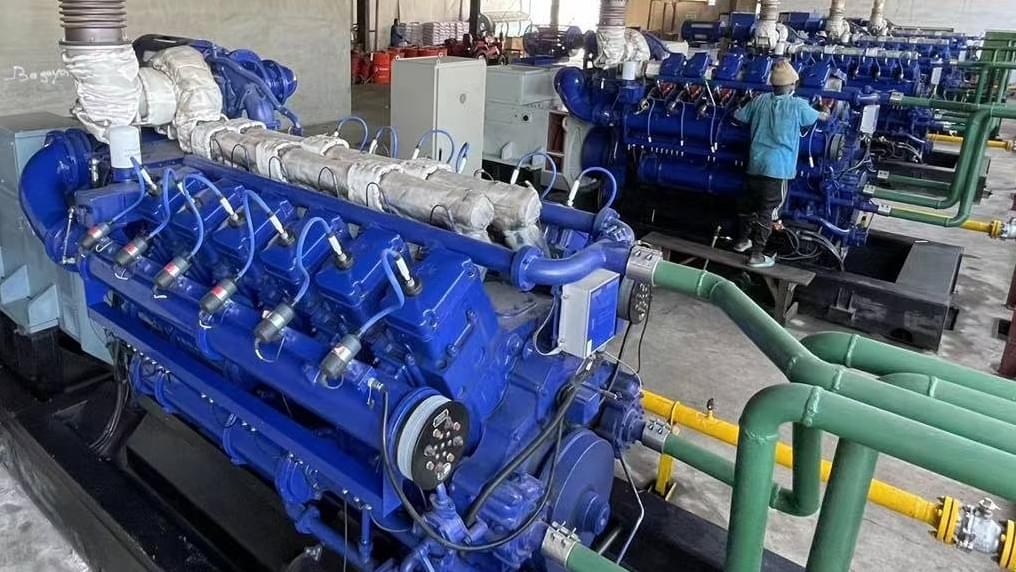
二、生物質氣化發電的核心設備類型
2、 Core equipment types for biomass gasification power generation
(一)氣化爐:生物質轉化的核心裝置氣化爐是決定生物質燃氣產量與品質的關鍵設備,根據爐內物料運動狀態和氣流方向,可分為固定床氣化爐、流化床氣化爐和氣流床氣化爐三大類,不同類型的氣化爐適用于不同特性的生物質原料和應用場景。固定床氣化爐結構簡單、造價低,適合處理顆粒均勻(直徑 5-50mm)、含水率較低(≤20%)的塊狀或顆粒狀原料(如木塊、秸稈壓塊)。其又可細分為上吸式、下吸式和橫吸式:上吸式固定床氣化爐中,原料從頂部加入,自上而下依次經歷干燥、熱解、氧化和還原階段,燃氣從頂部輸出,優點是熱效率高、焦油含量低,缺點是原料易結渣、不適用于高水分原料;下吸式固定床氣化爐則相反,原料自上而下運動,氣流自下而上流動,原料與燃氣逆向接觸,避免了焦油在原料層的冷凝,適合處理易結渣的原料(如秸稈),但熱效率略低于上吸式。流化床氣化爐采用石英砂、氧化鋁等惰性顆粒作為熱載體,通過從爐底通入的氣流使床層處于流化狀態,原料(粒徑通常為 1-10mm)與熱載體充分混合,反應溫度均勻(通常為 800-950℃),氣化效率高且適應原料范圍廣,無論是秸稈、稻殼還是木屑均可處理,尤其適合大規模連續運行。根據氣流速度和床層狀態,流化床氣化爐又可分為鼓泡流化床和循環流化床:循環流化床氣化爐通過提高氣流速度,使部分固體顆粒隨燃氣一起進入后續分離系統,分離后的顆粒返回爐內循環使用,進一步提升了原料轉化率和燃氣品質,目前在工業級生物質氣化項目中應用最為廣泛。氣流床氣化爐則適用于處理粉末狀原料(粒徑<1mm)或漿狀原料(如生物質漿液),通過將原料與氣化劑(氧氣或水蒸氣)以高速噴入爐內,在高溫(1200-1500℃)下瞬間完成氣化反應,具有反應速度快、產氣量大、無焦油生成的優點,但設備投資和運行成本較高,目前主要用于大型生物質綜合利用項目。
(1) Gasification furnace: The core device for biomass conversion. Gasification furnace is a key equipment that determines the production and quality of biomass gas. According to the material movement state and airflow direction inside the furnace, it can be divided into three categories: fixed bed gasification furnace, fluidized bed gasification furnace, and fluidized bed gasification furnace. Different types of gasification furnaces are suitable for biomass raw materials with different characteristics and application scenarios. The fixed bed gasifier has a simple structure and low cost, suitable for processing block or granular raw materials with uniform particles (diameter 5-50mm) and low moisture content (≤ 20%), such as wooden blocks and straw compacts. It can be further divided into upward suction, downward suction, and transverse suction: In an upward suction fixed bed gasifier, raw materials are added from the top and undergo drying, pyrolysis, oxidation, and reduction stages from top to bottom. Gas is output from the top, which has the advantages of high thermal efficiency and low tar content. The disadvantage is that raw materials are prone to slagging and are not suitable for high moisture raw materials; The downward suction fixed bed gasifier is the opposite, with raw materials moving from top to bottom and airflow flowing from bottom to top. The raw materials and gas come into reverse contact, avoiding tar condensation in the raw material layer. It is suitable for processing raw materials that are prone to slagging (such as straw), but the thermal efficiency is slightly lower than that of the upward suction. The fluidized bed gasifier uses inert particles such as quartz sand and alumina as heat carriers, and the bed is fluidized by the airflow introduced from the bottom of the furnace. The raw materials (usually 1-10mm in size) are fully mixed with the heat carrier, and the reaction temperature is uniform (usually 800-950 ℃). The gasification efficiency is high and it can adapt to a wide range of raw materials, whether it is straw, rice husk or sawdust, which can be processed, especially suitable for large-scale continuous operation. According to the airflow velocity and bed state, fluidized bed gasifiers can be divided into bubbling fluidized beds and circulating fluidized beds. Circulating fluidized bed gasifiers increase the airflow velocity to allow some solid particles to enter the subsequent separation system with the gas, and the separated particles are returned to the furnace for recycling, further improving the conversion rate of raw materials and gas quality. Currently, it is widely used in industrial biomass gasification projects. The fluidized bed gasifier is suitable for processing powdered raw materials (particle size<1mm) or slurry raw materials (such as biomass slurry). By injecting the raw materials and gasifying agents (oxygen or water vapor) into the furnace at high speed, the gasification reaction is completed instantly at high temperature (1200-1500 ℃). It has the advantages of fast reaction speed, large gas production, and no tar generation, but the equipment investment and operating costs are high. Currently, it is mainly used in large-scale biomass comprehensive utilization projects.
(二)氣體凈化設備:保障發電穩定的關鍵生物質燃氣在生成過程中會含有粉塵、焦油、硫化物、氮氧化物等雜質,若直接進入發電設備,會導致設備磨損、堵塞管道、腐蝕部件,甚至引發安全事故,因此必須通過凈化系統去除雜質。氣體凈化設備主要包括除塵設備、脫焦油設備和脫硫脫硝設備。除塵設備的核心作用是去除燃氣中的粉塵顆粒,常用設備有旋風分離器、布袋除塵器和靜電除塵器。旋風分離器利用離心力將粉塵從燃氣中分離,結構簡單、成本低,但對細顆粒(粒徑<5μm)的去除效率較低,通常作為初級除塵設備;布袋除塵器通過濾袋過濾粉塵,去除效率可達 99% 以上,能有效捕捉細顆粒,是目前應用最廣泛的二級除塵設備;靜電除塵器則利用高壓電場使粉塵帶電,再通過電吸附去除,適合處理大流量、高濃度粉塵的場景,但設備體積大、投資高。脫焦油設備是凈化系統的核心,目前主流技術包括物理法和化學法。物理法通過冷卻、吸收或過濾去除焦油,如采用水洗塔將燃氣冷卻至 40-60℃,使焦油冷凝為液體后與燃氣分離,或采用活性炭吸附塔吸附殘留焦油,優點是操作簡單,缺點是會產生焦油廢水,需后續處理;化學法則通過催化裂解將焦油轉化為一氧化碳、氫氣等可燃氣體,常用的催化劑有鎳基催化劑、白云石等,其中白云石成本低、來源廣,在中小規模項目中應用較多,而鎳基催化劑裂解效率高,適合對燃氣品質要求高的場景(如燃氣輪機發電)。脫硫脫硝設備主要用于去除燃氣中的硫化物(如硫化氫)和氮氧化物(如一氧化氮),避免其腐蝕設備和污染環境。脫硫常用干法(如氧化鐵脫硫劑吸附)和濕法(如胺液吸收),干法適合低硫燃氣,濕法適合高硫燃氣;脫硝則多采用選擇性催化還原法(SCR),在催化劑作用下,利用氨氣將氮氧化物還原為氮氣和水,確保燃氣排放符合環保標準。
(2) Gas purification equipment: The key biomass gas that ensures stable power generation contains impurities such as dust, tar, sulfides, and nitrogen oxides during the generation process. If it directly enters the power generation equipment, it can cause equipment wear, blockage of pipelines, corrosion of components, and even safety accidents. Therefore, impurities must be removed through a purification system. Gas purification equipment mainly includes dust removal equipment, tar removal equipment, and desulfurization and denitrification equipment. The core function of dust removal equipment is to remove dust particles from gas. Common equipment includes cyclone separators, bag filters, and electrostatic precipitators. Cyclone separators use centrifugal force to separate dust from gas, with a simple structure and low cost. However, their removal efficiency for fine particles (particle size<5 μ m) is relatively low, and they are usually used as primary dust removal equipment; The bag filter uses filter bags to filter dust, with a removal efficiency of over 99%. It can effectively capture fine particles and is currently the most widely used secondary dust removal equipment; Electrostatic precipitators use high-voltage electric fields to charge dust, which is then removed through electrode adsorption. They are suitable for handling high flow and high concentration dust scenarios, but the equipment has a large volume and high investment. The tar removal equipment is the core of the purification system, and the mainstream technologies currently include physical and chemical methods. Physical methods remove tar through cooling, absorption, or filtration, such as using a water washing tower to cool the gas to 40-60 ℃, condensing the tar into a liquid and separating it from the gas, or using an activated carbon adsorption tower to adsorb residual tar. The advantages are simple operation, but the disadvantages are that tar wastewater is generated, which requires subsequent treatment; Chemical laws convert tar into combustible gases such as carbon monoxide and hydrogen through catalytic cracking. Commonly used catalysts include nickel based catalysts and dolomite. Among them, dolomite has low cost and wide source, and is widely used in small and medium-sized projects. Nickel based catalysts have high cracking efficiency and are suitable for scenarios with high gas quality requirements (such as gas turbine power generation). The desulfurization and denitrification equipment is mainly used to remove sulfides (such as hydrogen sulfide) and nitrogen oxides (such as nitric oxide) from gas, avoiding their corrosion of equipment and environmental pollution. Dry methods (such as iron oxide desulfurizer adsorption) and wet methods (such as amine liquid absorption) are commonly used for desulfurization. Dry methods are suitable for low sulfur gas, while wet methods are suitable for high sulfur gas; Selective catalytic reduction (SCR) is commonly used for denitrification. Under the action of a catalyst, ammonia is used to reduce nitrogen oxides into nitrogen and water, ensuring that gas emissions meet environmental standards.
(三)發電設備:能量轉化的終端裝置發電設備根據規模和燃氣品質選擇,主要包括內燃機發電機組、汽輪機發電機組和燃氣輪機發電機組。內燃機發電機組由內燃機和發電機組成,燃氣進入內燃機氣缸燃燒產生動力,帶動發電機發電,單機容量通常為 5-1000kW,具有啟動快、安裝靈活、對燃氣壓力要求低的特點,適合農村分布式發電和小型工業項目,目前國內大多數村級生物質氣化發電站均采用這種設備。汽輪機發電機組則需配套鍋爐,將凈化后的燃氣在鍋爐內燃燒產生蒸汽,蒸汽推動汽輪機旋轉帶動發電機發電,單機容量可達 1000kW 以上,適合大規模集中發電項目(如利用林業剩余物的生物質電廠),但設備體積大、啟動時間長(通常需數小時),且對蒸汽參數(溫度、壓力)要求高,需嚴格控制燃氣燃燒穩定性。燃氣輪機發電機組通過燃氣在燃燒室燃燒產生高溫高壓氣體,直接推動渦輪旋轉帶動發電機發電,發電效率可達 35%-45%,遠高于內燃機和汽輪機,且啟動時間短(約 10-30 分鐘),但對燃氣純度要求(焦油含量需<10mg/m?),需配套精細凈化系統,設備投資和維護成本也較高,目前主要用于大型生物質氣化聯合循環發電項目(如生物質燃氣與天然氣混合發電)。
(3) Power generation equipment: Terminal devices for energy conversion. Power generation equipment is selected based on scale and gas quality, mainly including internal combustion engine generator sets, steam turbine generator sets, and gas turbine generator sets. The internal combustion engine generator set consists of an internal combustion engine and a generator. Gas enters the internal combustion engine cylinder and burns to generate power, driving the generator to generate electricity. The single unit capacity is usually 5-1000 kW, and it has the characteristics of fast start-up, flexible installation, and low gas pressure requirements. It is suitable for rural distributed power generation and small industrial projects. Currently, most village level biomass gasification power stations in China use this equipment. The steam turbine generator set needs to be equipped with a boiler, which burns the purified gas in the boiler to produce steam. The steam drives the steam turbine to rotate and drive the generator to generate electricity. The single unit capacity can reach more than 1000kW, which is suitable for large-scale centralized power generation projects (such as biomass power plants using forestry residues). However, the equipment has a large volume, long start-up time (usually several hours), and high requirements for steam parameters (temperature, pressure), requiring strict control of gas combustion stability. Gas turbine generator sets generate high-temperature and high-pressure gas through combustion of gas in the combustion chamber, which directly drives the turbine to rotate and drive the generator to generate electricity. The power generation efficiency can reach 35% -45%, which is much higher than that of internal combustion engines and steam turbines. The start-up time is short (about 10-30 minutes), but it requires extremely high gas purity (tar content<10mg/m)? )It requires a sophisticated purification system and has high equipment investment and maintenance costs. Currently, it is mainly used for large-scale biomass gasification combined cycle power generation projects (such as biomass gas and natural gas hybrid power generation).
三、生物質氣化發電系統的組成與工作流程一套完整的生物質氣化發電系統并非單一設備的簡單組合,而是由原料預處理系統、氣化系統、氣體凈化系統、發電系統和余熱利用系統組成的有機整體,各系統協同工作,確保能量轉化效率最大化。(一)原料預處理系統生物質原料(如秸稈、木屑、稻殼)通常存在含水率高、體積大、分布分散的問題,需通過預處理系統進行處理,使其滿足氣化爐進料要求。預處理流程主要包括破碎、干燥、成型三個環節:破碎環節通過破碎機將原料粉碎至符合氣化爐要求的粒徑(固定床需 5-50mm,流化床需 1-10mm),減少原料內部傳熱阻力,提升氣化效率;干燥環節利用熱風爐(通常采用氣化爐產生的余熱)將原料含水率從 30%-50% 降至 15%-20%,避免原料水分過高導致氣化溫度降低、燃氣產量減少;成型環節則針對松散的原料(如秸稈),通過成型機將其壓制成塊狀或顆粒狀,減少運輸成本,同時提高原料堆積密度,便于氣化爐連續進料。
3、 The composition and workflow of biomass gasification power generation system is a complete set of biomass gasification power generation system. It is not a simple combination of single equipment, but an organic whole composed of raw material pretreatment system, gasification system, gas purification system, power generation system and waste heat utilization system. The various systems work together to ensure maximum energy conversion efficiency. (1) The biomass raw materials (such as straw, sawdust, rice husk) in the raw material pretreatment system usually have problems of high moisture content, large volume, and dispersed distribution. They need to be processed through the pretreatment system to meet the requirements of gasification furnace feeding. The preprocessing process mainly includes three stages: crushing, drying, and forming. In the crushing stage, the raw materials are crushed by a crusher to a particle size that meets the requirements of the gasifier (5-50mm for fixed beds and 1-10mm for fluidized beds), reducing internal heat transfer resistance of the raw materials and improving gasification efficiency; In the drying process, a hot blast stove (usually using waste heat generated by a gasifier) is used to reduce the moisture content of the raw materials from 30% -50% to 15% -20%, avoiding a decrease in gasification temperature and gas production caused by excessive moisture content in the raw materials; The molding process targets loose raw materials (such as straw), which are pressed into blocks or granules by a molding machine to reduce transportation costs and increase the density of raw materials, making it easier for the gasifier to feed continuously.
(二)氣化系統氣化系統以氣化爐為核心,配套鼓風機、加料機、排渣機等輔助設備,完成生物質原料的熱化學轉化。工作時,預處理后的原料通過加料機均勻送入氣化爐,同時鼓風機將氣化劑(空氣、氧氣或水蒸氣)按一定比例通入爐內,原料在爐內經歷干燥、熱解、氧化、還原反應后生成生物質燃氣;氣化爐底部的排渣機則定期排出反應后的灰渣(灰渣可作為有機肥或建筑材料),確保爐內物料連續流動。為維持爐內溫度穩定,部分氣化爐還配套有溫度控制系統,通過調節氣化劑供應量或原料進料速度,將反應溫度控制在最佳范圍。
(2) The gasification system is centered around a gasifier and equipped with auxiliary equipment such as blowers, feeders, and slag discharge machines to complete the thermochemical conversion of biomass raw materials. During operation, the pre treated raw materials are uniformly fed into the gasifier through a feeding machine, while a blower introduces gasification agents (air, oxygen, or water vapor) into the furnace in a certain proportion. The raw materials undergo drying, pyrolysis, oxidation, and reduction reactions in the furnace to generate biomass gas; The slag discharge machine at the bottom of the gasifier regularly discharges the reacted ash (which can be used as organic fertilizer or building materials) to ensure continuous flow of materials inside the furnace. To maintain stable temperature inside the furnace, some gasifiers are also equipped with temperature control systems, which control the reaction temperature within the optimal range by adjusting the supply of gasifying agents or the feed rate of raw materials.
(三)氣體凈化系統從氣化爐輸出的生物質燃氣溫度較高(通常為 400-600℃),且含有大量雜質,需通過凈化系統進行降溫、除塵、脫焦油和脫硫脫硝處理。首先,高溫燃氣進入冷卻器(如水冷套管或空氣冷卻器),溫度降至 40-60℃,使部分焦油和水蒸氣冷凝;隨后進入旋風分離器進行初級除塵,去除大部分粉塵顆粒;接著進入布袋除塵器,進一步去除細顆粒粉塵;之后進入脫焦油設備(如水洗塔或催化裂解塔),去除燃氣中的焦油;最后進入脫硫脫硝設備,去除硫化物和氮氧化物,凈化后的燃氣(焦油含量<50mg/m?、粉塵含量<10mg/m?)送入儲氣柜暫存,等待進入發電系統。(四)發電系統與余熱利用儲氣柜中的生物質燃氣經穩壓后,根據系統規模和設備類型送入內燃機、汽輪機或燃氣輪機:若為內燃機發電系統,燃氣直接進入內燃機與空氣混合燃燒,驅動發電機發電;若為汽輪機發電系統,燃氣先進入鍋爐燃燒產生蒸汽,再推動汽輪機帶動發電機;若為燃氣輪機發電系統,燃氣則進入燃燒室與空氣混合燃燒,產生高溫高壓氣體推動渦輪旋轉。發電過程中會產生大量余熱(如內燃機排氣溫度可達 400-600℃,汽輪機乏汽溫度可達 100-150℃),若直接排放會造成能量浪費,因此系統通常配套余熱利用系統:余熱鍋爐利用高溫煙氣加熱水生成蒸汽,為廠區提供供暖或生活用熱水;或通過余熱換熱器加熱冷空氣,作為氣化爐的氣化劑或原料干燥系統的熱源,實現能量梯級利用,使整個系統的綜合能效提升 10%-20%。
(3) The biomass gas output from the gasifier by the gas purification system has a high temperature (usually 400-600 ℃) and contains a large amount of impurities, which require cooling, dust removal, tar removal, and desulfurization/denitrification treatment through the purification system. Firstly, high-temperature gas enters a cooler (such as a water-cooled sleeve or air cooler), where the temperature drops to 40-60 ℃, causing some tar and water vapor to condense; Subsequently, it enters the cyclone separator for primary dust removal, removing most of the dust particles; Then enter the bag filter to further remove fine particulate dust; Afterwards, it enters the tar removal equipment (such as water washing tower or catalytic cracking tower) to remove tar from the gas; Finally, enter the desulfurization and denitrification equipment to remove sulfides and nitrogen oxides, and purify the gas (tar content<50mg/m?)? Dust content<10mg/m? )Sent to the storage tank for temporary storage, waiting to enter the power generation system. (4) After the biomass gas in the power generation system and waste heat utilization storage tank is stabilized, it is sent to the internal combustion engine, steam turbine or gas turbine according to the system scale and equipment type. If it is an internal combustion engine power generation system, the gas directly enters the internal combustion engine and mixes with air for combustion, driving the generator to generate electricity; If it is a steam turbine power generation system, the gas first enters the boiler for combustion to produce steam, and then drives the turbine to drive the generator; If it is a gas turbine power generation system, the gas enters the combustion chamber and mixes with air for combustion, producing high-temperature and high-pressure gas to drive the turbine to rotate. During the power generation process, a large amount of waste heat is generated (such as the exhaust temperature of internal combustion engines reaching 400-600 ℃ and the exhaust temperature of steam turbines reaching 100-150 ℃). Direct discharge can cause energy waste. Therefore, the system is usually equipped with a waste heat utilization system: a waste heat boiler uses high-temperature flue gas to heat water and generate steam, providing heating or domestic hot water for the factory area; Alternatively, cold air can be heated through a waste heat exchanger to serve as a gasification agent for the gasifier or a heat source for the raw material drying system, achieving energy cascade utilization and increasing the overall energy efficiency of the system by 10% -20%.
四、生物質氣化發電設備及系統的應用場景(一)農村分布式發電在我國農村地區,每年產生大量秸稈、稻殼、玉米芯等農業廢棄物,若隨意焚燒不僅污染環境,還浪費資源。農村分布式生物質氣化發電系統(單機容量通常為 10-100kW)可利用當地農業廢棄物作為原料,發電直接供給農戶或農村小微企業,多余電量并入電網,實現 “就地取材、就地發電、就地消納”。例如,在我國山東、河南等地的農村,許多村級生物質氣化發電站以秸稈為原料,不僅解決了秸稈焚燒問題,還為村民提供了穩定的電力供應,同時發電產生的灰渣可作為有機肥還田,形成 “農業廢棄物 - 發電 - 有機肥 - 農業生產” 的循環經濟模式。
4、 Application scenarios of biomass gasification power generation equipment and systems (1) Rural distributed power generation In rural areas of China, a large amount of agricultural waste such as straw, rice husk, corn cob, etc. is generated every year. If burned indiscriminately, it not only pollutes the environment but also wastes resources. The rural distributed biomass gasification power generation system (usually with a single unit capacity of 10-100kW) can use local agricultural waste as raw materials to generate electricity directly to farmers or rural small and micro enterprises, and the excess electricity is integrated into the power grid, achieving "local materials, local power generation, and local consumption". For example, in rural areas such as Shandong and Henan in China, many village level biomass gasification power plants use straw as raw material, which not only solves the problem of straw burning, but also provides stable power supply for villagers. At the same time, the ash generated by power generation can be used as organic fertilizer for returning to the field, forming a circular economy model of "agricultural waste power generation organic fertilizer agricultural production".
(二)工業園區自備電站工業園區(如食品加工、造紙、木材加工園區)在生產過程中會產生大量有機廢棄物(如食品殘渣、造紙污泥、木材邊角料),這些廢棄物具有較高的熱值,適合作為生物質氣化發電的原料。工業園區自備電站(單機容量通常為 100-1000kW)可將這些廢棄物轉化為電能,為園區企業提供生產用電,降低企業用電成本;同時,發電產生的余熱可用于園區供暖或生產用蒸汽,實現能源的綜合利用。例如,我國江蘇某木材加工園區采用循環流化床氣化爐,以木材邊角料為原料,配套汽輪機發電機組,年發電量達 800 萬度,不僅滿足了園區 30% 的用電需求,還減少了木材廢棄物的填埋量,每年節約標準煤約 3000 噸。
(2) Industrial parks with their own power stations (such as food processing, papermaking, and wood processing parks) generate a large amount of organic waste (such as food residues, papermaking sludge, and wood scraps) during the production process. These wastes have high calorific values and are suitable as raw materials for biomass gasification power generation. The self owned power station in the industrial park (usually with a single unit capacity of 100-1000kW) can convert these wastes into electricity, providing production electricity for park enterprises and reducing their electricity costs; At the same time, the waste heat generated by power generation can be used for heating or steam production in the park, achieving comprehensive energy utilization. For example, a wood processing park in Jiangsu Province, China, uses a circulating fluidized bed gasifier with wood scraps as raw materials and is equipped with a steam turbine generator set. The annual power generation reaches 8 million kWh, which not only meets 30% of the park's electricity demand, but also reduces the amount of wood waste buried, saving about 3000 tons of standard coal per year.
(三)偏遠地區離網供電在我國西部偏遠山區、高原牧區等電網覆蓋困難的區域,傳統電力供應成本高、穩定性差,而當地豐富的林業剩余物(如枯枝、灌木)為生物質氣化發電提供了充足原料。離網型生物質氣化發電系統(單機容量通常為 5-50kW)可作為這些區域的主要供電來源,為居民生活、學校、衛生院等提供穩定電力。例如,我國西藏某牧區采用下吸式固定床氣化爐,以當地枯枝為原料,配套內燃機發電機組,為牧區 200 余戶居民提供用電,解決了牧民的照明、電視、冰箱等基本用電需求,改善了當地生活條件。
(3) Off grid power supply in remote areas of western China, such as remote mountainous regions and high-altitude pastoral areas where power grid coverage is difficult, traditional power supply has high costs and poor stability. However, the abundant forestry residues (such as dead branches and shrubs) in the area provide sufficient raw materials for biomass gasification power generation. Off grid biomass gasification power generation systems (usually with a single unit capacity of 5-50kW) can serve as the main power source for these areas, providing stable electricity for residents' daily lives, schools, health clinics, etc. For example, a pastoral area in Xizang, China, uses a downdraft fixed bed gasifier, which uses local dead branches as raw materials, and is equipped with internal combustion engine generator sets to provide power for more than 200 households in the pastoral area. This has solved the basic power needs of herdsmen for lighting, television, refrigerators, and improved local living conditions.
五、生物質氣化發電設備及系統面臨的挑戰與未來發展盡管生物質氣化發電技術已取得顯著進展,但在實際應用中仍面臨諸多挑戰:一是原料供應不穩定,生物質原料具有季節性(如秸稈主要在秋收后產生)和分散性,收集、運輸成本較高,導致部分項目因原料短缺或成本過高而難以持續運行;
5、 The challenges and future development of biomass gasification power generation equipment and systems. Although biomass gasification power generation technology has made significant progress, it still faces many challenges in practical applications: firstly, the supply of raw materials is unstable, biomass raw materials have seasonality (such as straw mainly produced after autumn harvest) and dispersion, and the collection and transportation costs are high, resulting in some projects being difficult to sustain due to raw material shortages or high costs;
二是設備效率有待提升,中小規模系統(尤其是 100kW 以下)的氣化效率和發電效率較低,綜合能效通常僅為 20%-30%,難以與傳統化石能源發電競爭;
Secondly, the equipment efficiency needs to be improved. The gasification efficiency and power generation efficiency of small and medium-sized systems (especially below 100kW) are relatively low, with a comprehensive energy efficiency usually only 20% -30%, making it difficult to compete with traditional fossil fuel power generation;
三是技術瓶頸尚未完全突破,焦油處理仍是行業難題,現有脫焦油技術要么成本高,要么會產生二次污染,影響系統穩定性和經濟性;
Thirdly, the technological bottleneck has not been completely overcome, and tar treatment is still a difficult problem in the industry. Existing tar removal technologies either have high costs or generate secondary pollution, which affects system stability and economy;
四是政策支持力度不足,相比風電、光伏等可再生能源,生物質氣化發電的補貼政策和市場機制不夠完善,項目投資回報周期長,企業積性不高。針對這些挑戰,未來生物質氣化發電設備及系統的發展將朝著以下方向推進:一是技術升級,研發、低耗的氣化爐(如超高溫氣化爐、分級氣化爐)和凈化設備(如新型催化裂解催化劑、脫硫脫硝技術),提升燃氣品質和系統效率,目標將綜合能效提高至 40% 以上;
Fourthly, there is insufficient policy support. Compared to renewable energy sources such as wind power and photovoltaics, the subsidy policies and market mechanisms for biomass gasification power generation are not perfect, the investment return cycle of projects is long, and the enthusiasm of enterprises is not high. In response to these challenges, the future development of biomass gasification power generation equipment and systems will move towards the following directions: firstly, technological upgrading, research and development of efficient and low consumption gasifiers (such as ultra-high temperature gasifiers and staged gasifiers) and purification equipment (such as new catalytic cracking catalysts and high-efficiency desulfurization and denitrification technologies), improving gas quality and system efficiency, with the goal of increasing comprehensive energy efficiency to over 40%;
二是原料多元化,開發以畜禽糞便、城市有機垃圾、能源作物為原料的氣化技術,拓展原料來源,解決原料供應不穩定問題;三是系統集成化,推動生物質氣化發電與余熱利用、生物質制氫、生物質炭生產等技術結合,形成多聯產系統,提高項目經濟效益;四是智能化,引入物聯網、大數據等技術,實現原料供應、設備運行、故障診斷的智能化管理,降低運行成本,提升系統穩定性;五是政策完善,加大對生物質氣化發電項目的補貼力度,建立健全生物質能源市場交易機制,鼓勵企業和社會資本參與項目建設,推動行業規模化、產業化發展。六、結語生物質氣化發電設備及系統作為一種清潔、的可再生能源利用技術,不僅為農業、林業廢棄物的資源化利用提供了有效途徑,還為能源結構轉型和 “雙碳” 目標實現提供了重要支撐。盡管目前仍面臨原料、技術、政策等方面的挑戰,但隨著技術的不斷突破和產業環境的逐步完善,生物質氣化發電必將在農村能源供應、工業園區節能、偏遠地區供電等領域發揮更大作用,成為未來能源體系的重要組成部分。
The second is to diversify raw materials, develop gasification technologies using livestock and poultry manure, urban organic waste, and energy crops as raw materials, expand raw material sources, and solve the problem of unstable raw material supply; The third is system integration, promoting the integration of biomass gasification power generation with waste heat utilization, biomass hydrogen production, biomass charcoal production and other technologies, forming a multi generation system, and improving project economic benefits; The fourth is intelligence, which introduces technologies such as the Internet of Things and big data to achieve intelligent management of raw material supply, equipment operation, and fault diagnosis, reduce operating costs, and improve system stability; The fifth is to improve policies, increase subsidies for biomass gasification power generation projects, establish and improve the trading mechanism of biomass energy market, encourage enterprises and social capital to participate in project construction, and promote the scale and industrialization development of the industry. 6、 Conclusion: Biomass gasification power generation equipment and systems, as a clean and efficient renewable energy utilization technology, not only provide effective ways for the resource utilization of agricultural and forestry waste, but also provide important support for the transformation of energy structure and the achievement of "dual carbon" goals. Despite facing challenges in terms of raw materials, technology, policies, etc., with the continuous breakthroughs in technology and the gradual improvement of the industrial environment, biomass gasification power generation will play a greater role in rural energy supply, energy conservation in industrial parks, and power supply in remote areas, becoming an important component of the future energy system.
本文由 生物質氣發電機組 友情奉獻.更多有關的知識請點擊 http://www.kmy0823.com/ 真誠的態度.為您提供為的服務.更多有關的知識我們將會陸續向大家奉獻.敬請期待.
This article is a friendly contribution from biomass gas generators For more related knowledge, please click http://www.kmy0823.com/ Sincere attitude To provide you with comprehensive services We will gradually contribute more relevant knowledge to everyone Coming soon.

掃一掃了解更多

掃一掃了解更多